
How GS‑441524 Cures FIP?
2025-05-15
What Is FIP?
Feline Infectious Peritonitis (FIP) is a fatal disease caused by a mutated feline coronavirus (FCoV). For decades, it was nearly 100% lethal—until GS‑441524 arrived.
*FCoV is an enveloped, single‑stranded RNA virus. Its core enzyme: RNA‑dependent RNA polymerase (RdRp)—the machine that copies viral RNA.*
What Is GS‑441524?
GS‑441524 is a nucleoside analogue (a “fake building block” for RNA) and the active metabolite of remdesivir. It is the gold‑standard treatment for FIP, with 80–92% survival rates when used correctly.
How GS‑441524 Works
1. Entry & Activation
GS‑441524 enters infected cells.
Inside the cell, it is triple‑phosphorylated (3 phosphate groups added) to become its active form: GS‑443902.
2. The “Stop Sign” Mechanism
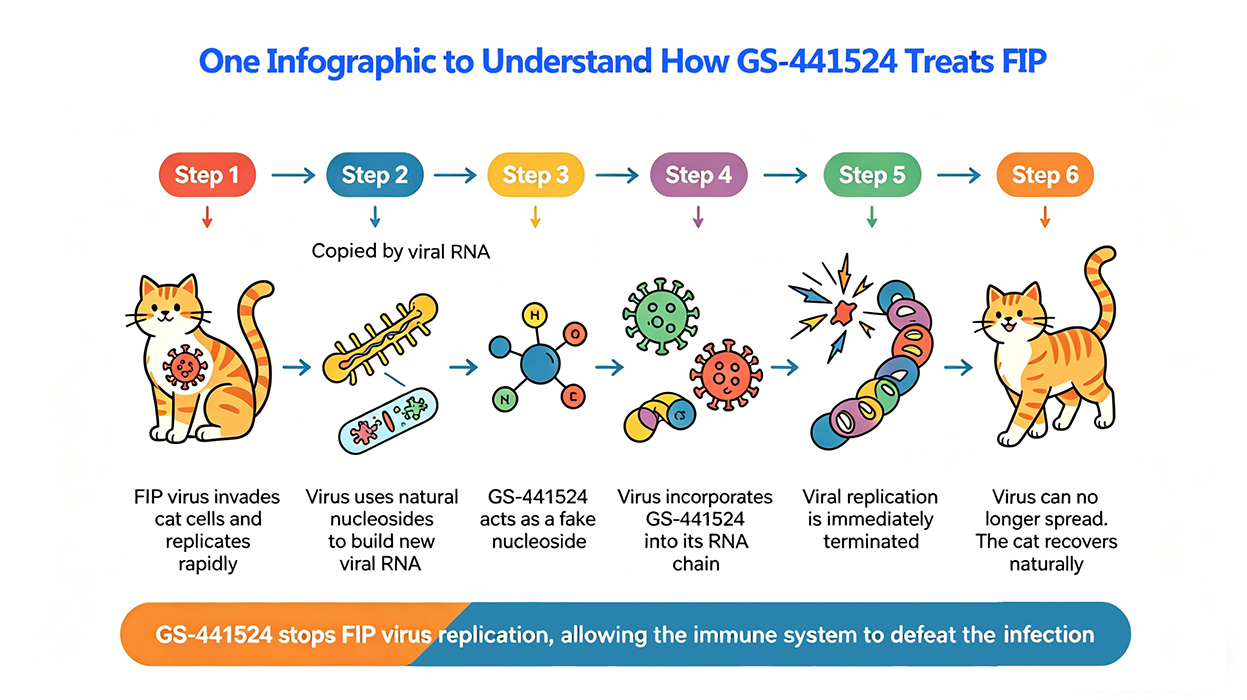
FCoV uses its RdRp enzyme to copy its RNA genome and make new viruses.
GS‑443902 mimics adenosine triphosphate (ATP)—one of the four natural building blocks of RNA.
RdRp mistakes GS‑443902 for ATP and inserts it into the growing viral RNA chain.
Because GS‑443902 lacks a 3′‑hydroxyl group, no next nucleotide can attach.
Viral RNA synthesis stops dead. The virus cannot replicate or make new infectious particles.
Left: Normal viral RNA replication. Right: GS‑441524 inserts and blocks further elongation.
3. Outcome
No new viruses = infected cells stop producing virus.
The cat’s immune system can then clear remaining infected cells.
Clinical signs (effusion, fever, weight loss) resolve, and the cat recovers.
Key Facts
Target: FCoV RNA‑dependent RNA polymerase (RdRp).
Action: Premature chain termination of viral RNA synthesis.
Formulations: Injectable and oral (e.g., Pronidesivir®).
EC₅₀: ~0.78 μM (very potent against FIPV).
Relation to Remdesivir: GS‑441524 is remdesivir’s active metabolite.
Why This Is a Game‑Changer
Before GS‑441524, FIP was a death sentence. Now, early diagnosis + proper GS‑441524 treatment gives cats a high chance of full recovery.