Standard Medication Plan, Injection Operation & Supportive Care
2025-08-08
Standard Medication Plan, Injection Operation & Supportive Care

1. Graded Dosage Standards (by FIP type)
Dosage is calculated based on the cat’s body weight (kg):
• Wet / Dry FIP (no eye or nerve lesions): 5mg/kg ~ 6mg/kg per day
• Ocular FIP (combined with wet/dry FIP): Minimum 8mg/kg per day
• Neurological FIP: Minimum 10mg/kg per day
• Relapsed cases: Increase 5mg/kg on the original dosage
For intractable severe cases, the dosage can be raised above 15mg/kg under professional guidance.
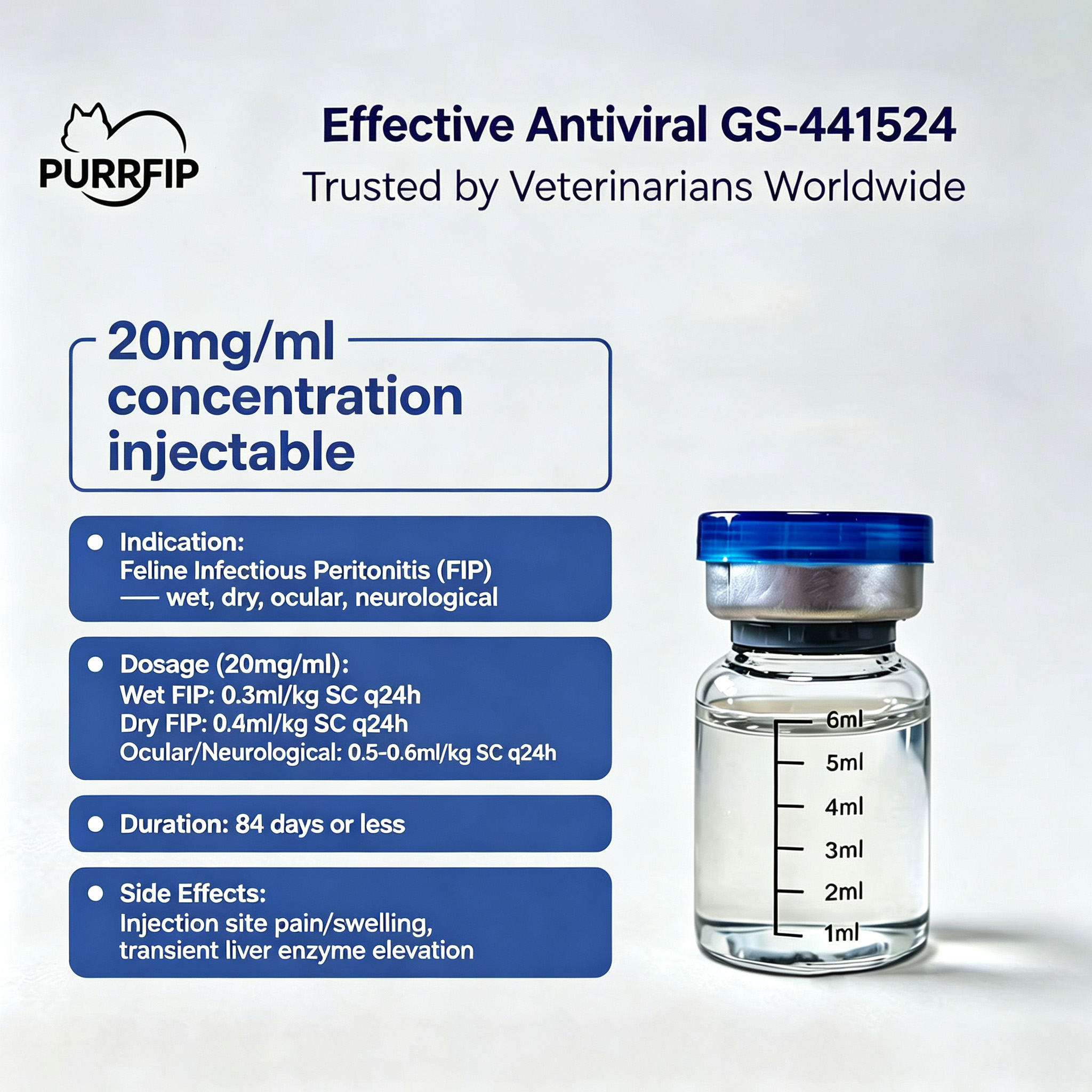
GS-441524 liquid has three common concentrations: 15mg/mL, 20mg/mL, 30mg/mL. Higher concentration means smaller injection volume, which is more friendly for large cats with high dosage.
If the cat’s condition is unstable or deteriorates in the early stage, adopt twice-daily administration (full dose every 12 hours); adjust to once every 24 hours after the condition stabilizes.
2. Subcutaneous Injection Operation Guide
All injections are subcutaneous injections (under the skin), not intramuscular injections.
1. Syringe & Needle: Use 3mL syringes. Draw medicine with 18G/20G thick needles, then replace with 21G/22G thin needles for injection. Insulin needles are not applicable.
2. Injection Site: Choose the loose skin on the back, between shoulder blades (lower scruff). Rotate injection sites every day to avoid repeated stabbing at the same position.
3. Handling Leakage: If medicine leaks out, re-inject half of the total dose; if most liquid leaks, re-inject the full dose. Clean the skin with diluted dish soap after leakage.
4. Missed Dose: Try to inject within 1 hour of the fixed time. A single missed dose will not cause major problems, but long-term missed doses are prohibited.
GS-441524 cannot cure FIP alone. Comprehensive supportive care is essential:
1. Body Fluid Management: Do not drain abdominal fluid casually; only drain less than 30% when breathing, eating and defecation are severely affected. Chest fluid must be completely drained once breathing is difficult.
2. Assisted Feeding: Cats refusing food need syringe feeding to prevent fatty liver. Adult cats need 200 calories per day, kittens need 250 calories per day.
3. Corticosteroids: Short-acting prednisolone or dexamethasone can be used to stabilize the condition in the early stage, and gradually stop using it within 3 weeks.
4. Regular Testing: Complete CBC and biochemical panel every 4 weeks. Arrange final blood tests around the 80th day to evaluate the effect before the 84-day treatment ends.